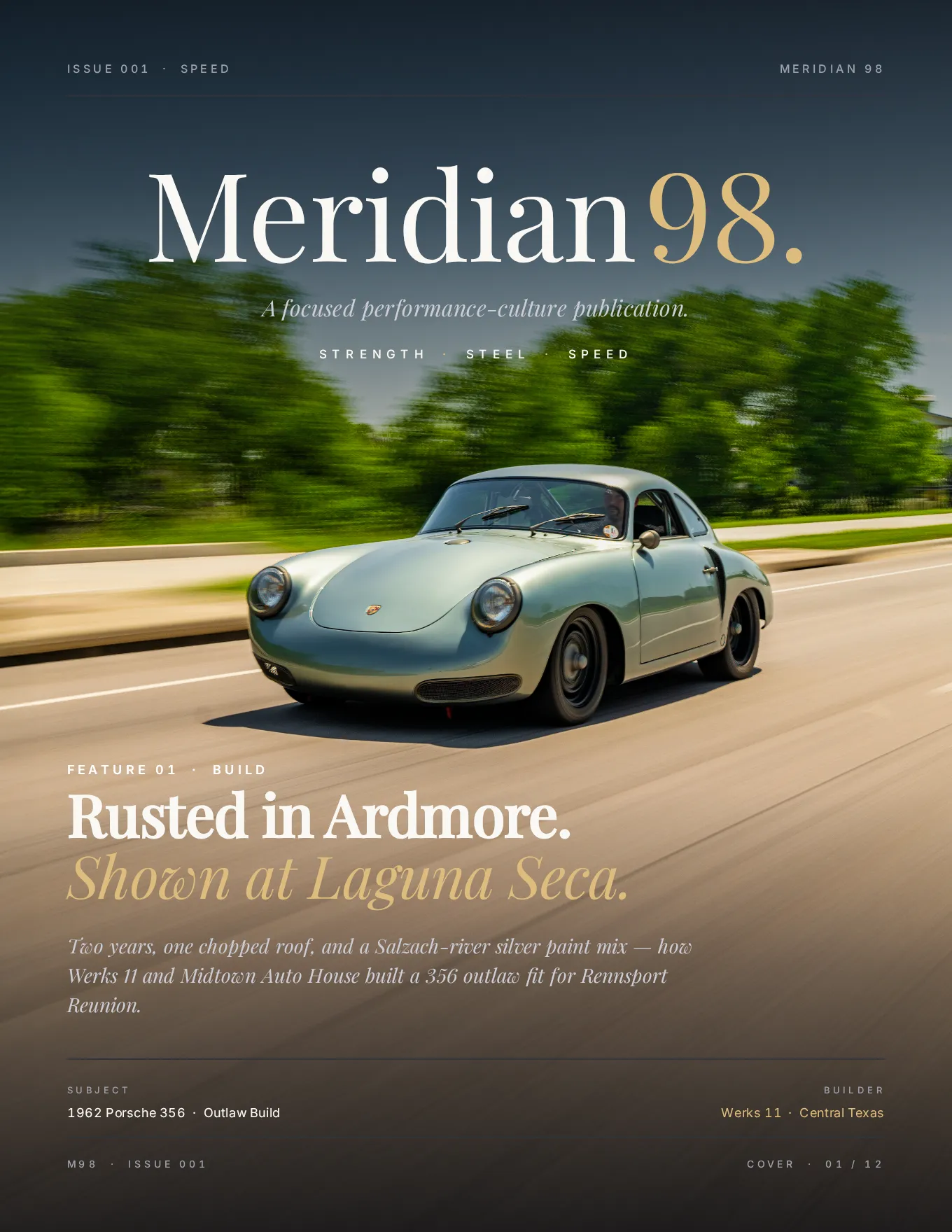
PREFACE ·THREE STORAGE UNITS, ONE WORKSHOP
A Tale of Two Storage Units, and One Workshop in Between.
The shell sat in southern Oklahoma for thirty years. The Sprinter that brought its new owners to central Texas had four hundred miles on it when they bought it. The 356 they drove home - different car entirely.
Some cars exist to be driven. Some cars exist to be looked at. A few cars exist to do something rarer: to prove what’s possible when the people who care about a thing decide it’s worth two years of their attention.
This is the story of one of those cars - a 1956 Porsche 356 found in a storage unit in Ardmore, Oklahoma, by Brett and Jessica Nelson of Midtown Autohaus in Oklahoma City, and rebuilt by Julian Avent and his team at Werks 11 in central Texas.
It is not a story about horsepower, though the horsepower is real. It is not a story about chrome, though the absence of chrome is intentional. It is a story about restraint - the kind of build that takes longer than expected because every decision was made on purpose.
The car was selected for the Outlaw 356 paddock at Rennsport Reunion 7. Fifteen cars were chosen. This was one of them.
Two years. One car. Eleven chapters.
Contents
- I The Find A yellow shell, thirty years still. 03
- II The Partnership Two energetic people who arrived in a Sprinter. 04
- III The Decision Type 4, not 911. 05
- IV The Bodywork A roof raked forward, every panel touched. 06
- V The Engine Built like a 911R wished it could be. 07
- VI The Finishes Salzach silver, named for a river photo. 08
- VII The Interior Bespoke knobs, a donated wheel. 09
- VIII The Mechanical Three sets of glass, one suspension. 10
- IX The Testing Twelve hundred miles before handoff. 11
- X The Showing Rennsport. Manual Focus. Luftgekuhlt. 12
- XI The Landing Far greater than they could have imagined. 13
- - Colophon A note on method and matter. 14
CHAPTER I · THE FIND
A yellow shell, thirty years still.
The car had not run since the early nineties. It had not been touched since not long after that. And the people who eventually bought it had been in business less than a year.
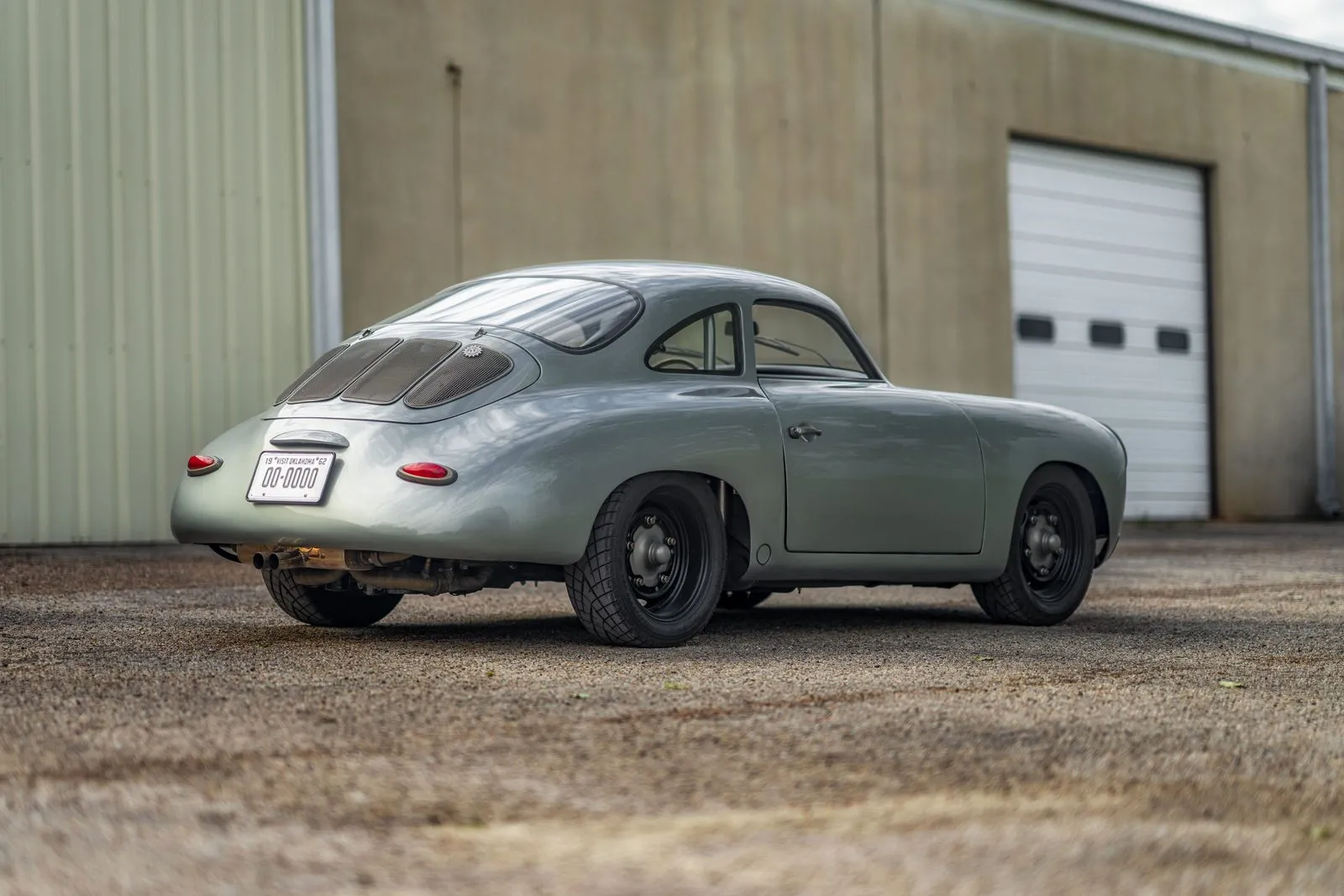
In 2021, Brett and Jessica Nelson were a few months into running Midtown Autohaus - an automotive storage facility and social club in Midtown, Oklahoma City - when a friend called Brett about a car. There was a yellow Porsche, the friend said, in a storage unit down in Ardmore, two hours south on I-35. The owner had stopped working on it sometime in the early nineties. It had been there ever since.
A few days later the Nelsons were in Ardmore meeting the owner, a retired physician and former Baja 1000 class winner from the late nineties. His nephew had once decided to help the doctor restore the 356. The nephew had taken the car apart. The nephew had then run out of momentum, and the car - disassembled, in pieces, no longer recognizable as the thing it had once been - had simply sat there.
CHAPTER II · THE PARTNERSHIP
Two energetic people who arrived in a Sprinter.
The Nelsons had been talking to Werks 11 about other projects. Bringing them this one - the shell, the dream, the partnership - was the conversation that turned a workshop relationship into something else.
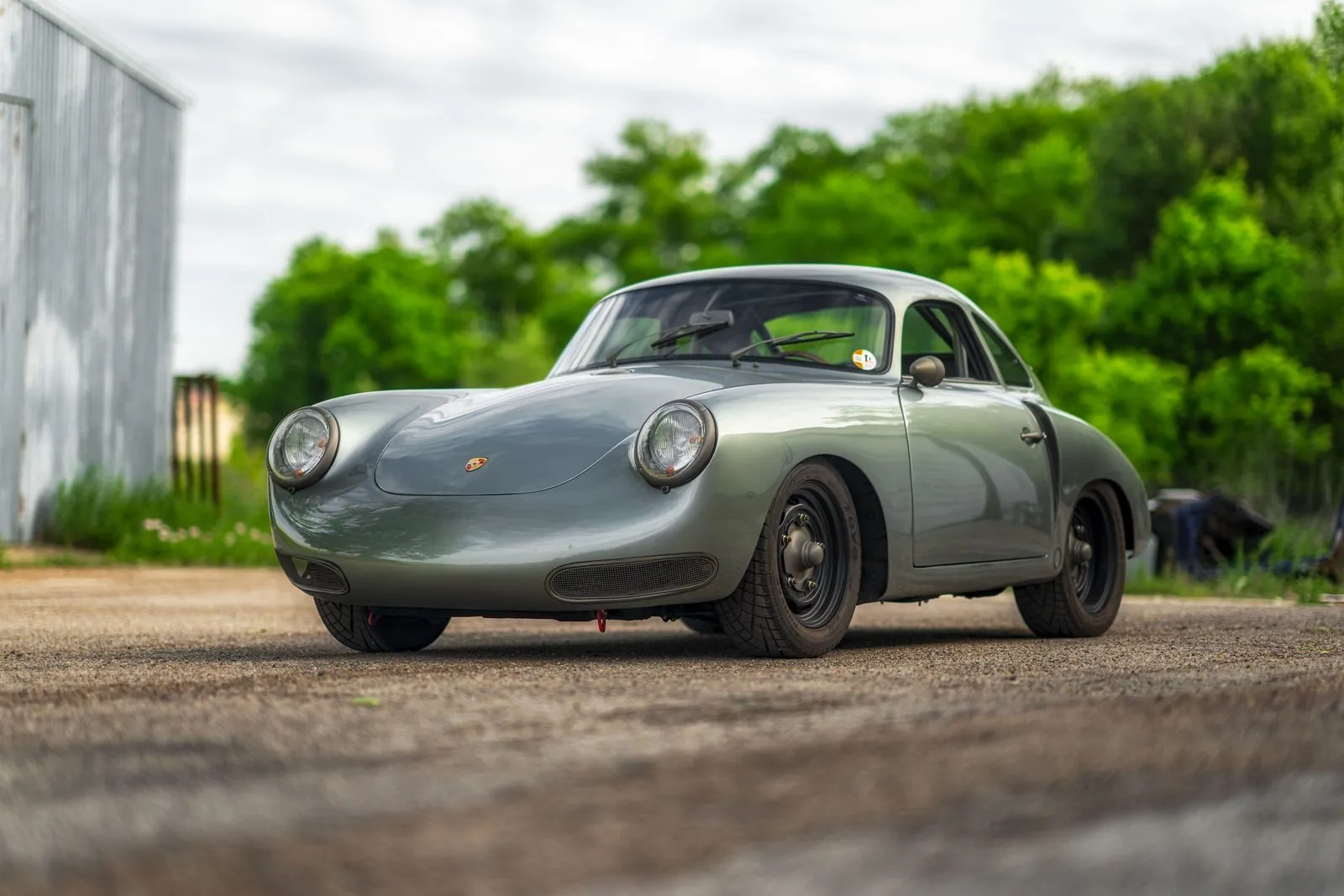
Werks 11 sits in central Texas. Julian Avent has been working on Porsches since he was seventeen years old. The shop became a brick-and-mortar operation around 2015 or 2016 - air-cooled work, predominantly 911s, 912s, and 356s - with engine building, body and paintwork, and upholstery all handled in-house. They were the right shop for the project.
CHAPTER III · THE DECISION
Type 4, not 911.
The Nelsons wanted horsepower. Real horsepower - enough to pull across state lines without complaint. The conventional answer was a 911 motor. Werks 11 didn’t take it.
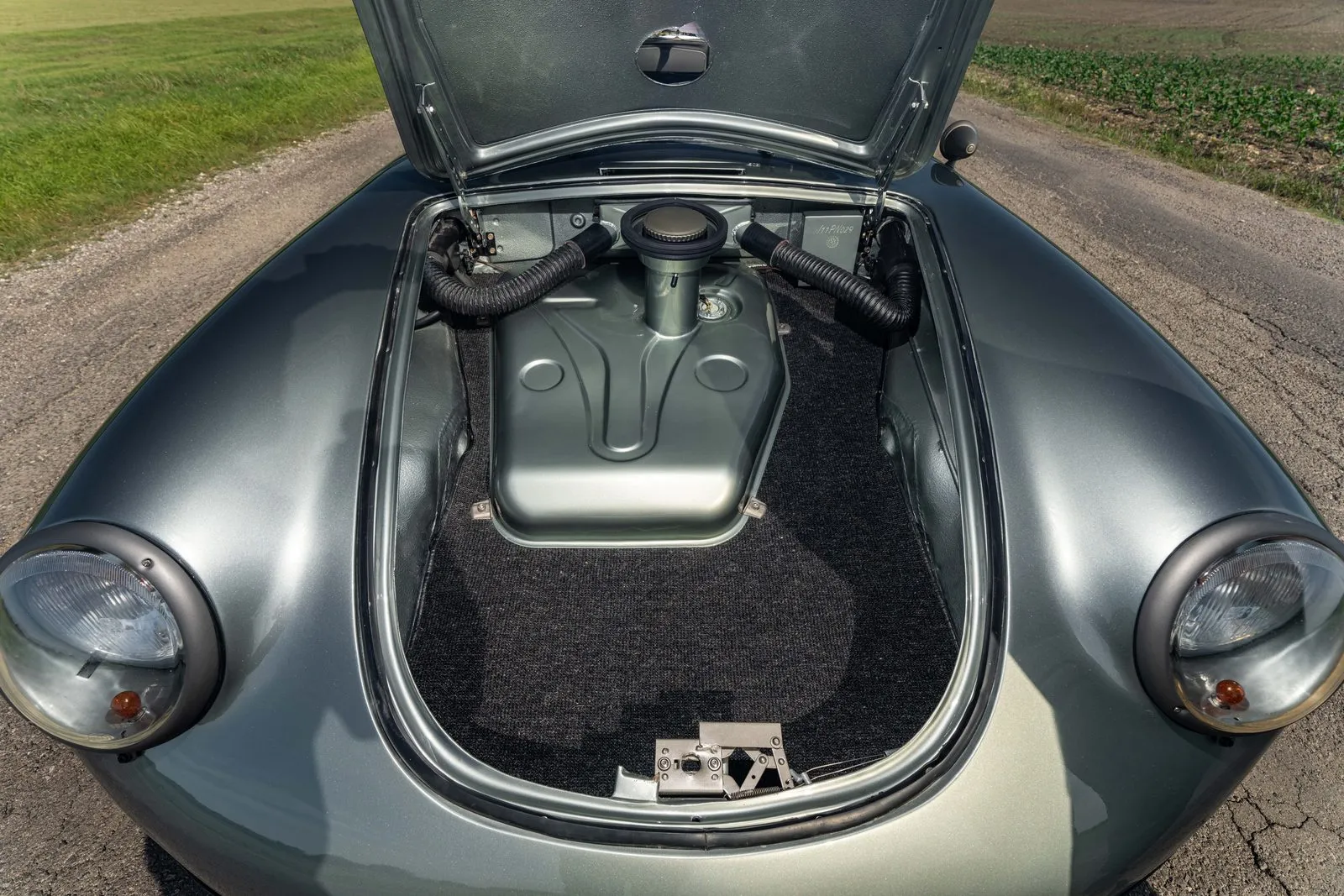
The first major decision in any 356 Outlaw build is what to put in the back. The conventional move - the one that lets the build clear sixty in low-fives and feel like a modern car doing it - is to drop in a six-cylinder 911 motor. It works. It also changes the car.
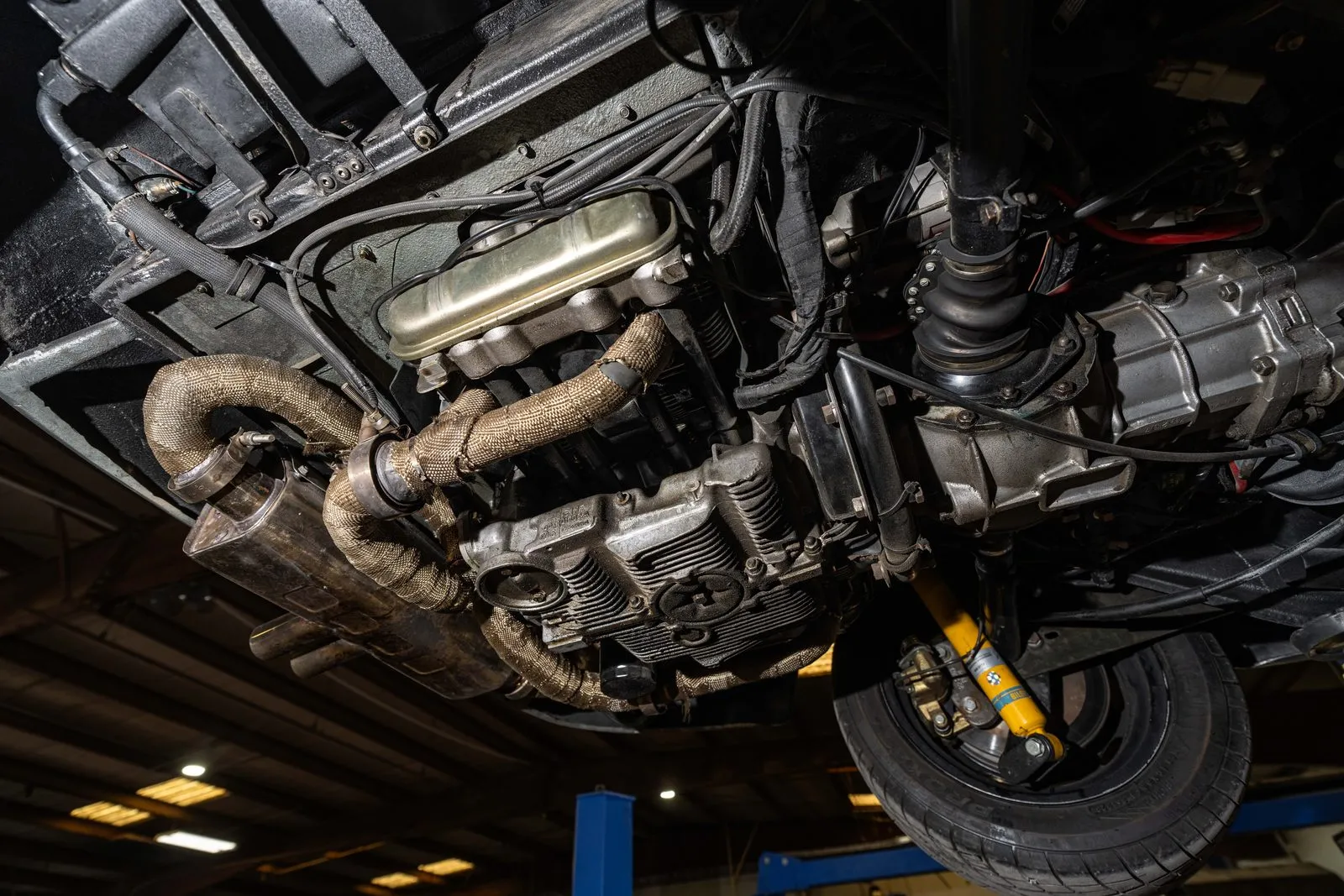
Julian and the Nelsons talked about it at length. They didn’t go that direction. They built a detuned Type 4 race motor instead - derived from the 914 race engines Werks 11 had been running for seven or eight years - with modern fuel injection on individual throttle bodies and a Link ECU. Output: somewhere north of 150 horsepower, in a car that weighs just over 1,800 pounds.
More horsepower was the conventional answer. The same horsepower, in a car that still felt like itself, was the right one.
Powerplant & Drivetrain
- Engine
- Type 4, derived from 914 race program - detuned for road use
- Induction
- Individual throttle bodies (ITBs) - modern injection
- ECU
- Link
- Output
- ~150+ horsepower (estimated)
- Curb weight
- ~1,800 lb
- Power-to-weight
- ~12 lb/hp
- Transmission
- 4-speed, short-shift conversion
CHAPTER IV · THE BODYWORK
A roof raked forward, every panel touched.
The most distinctive decision Werks 11 made on this car was at the top.
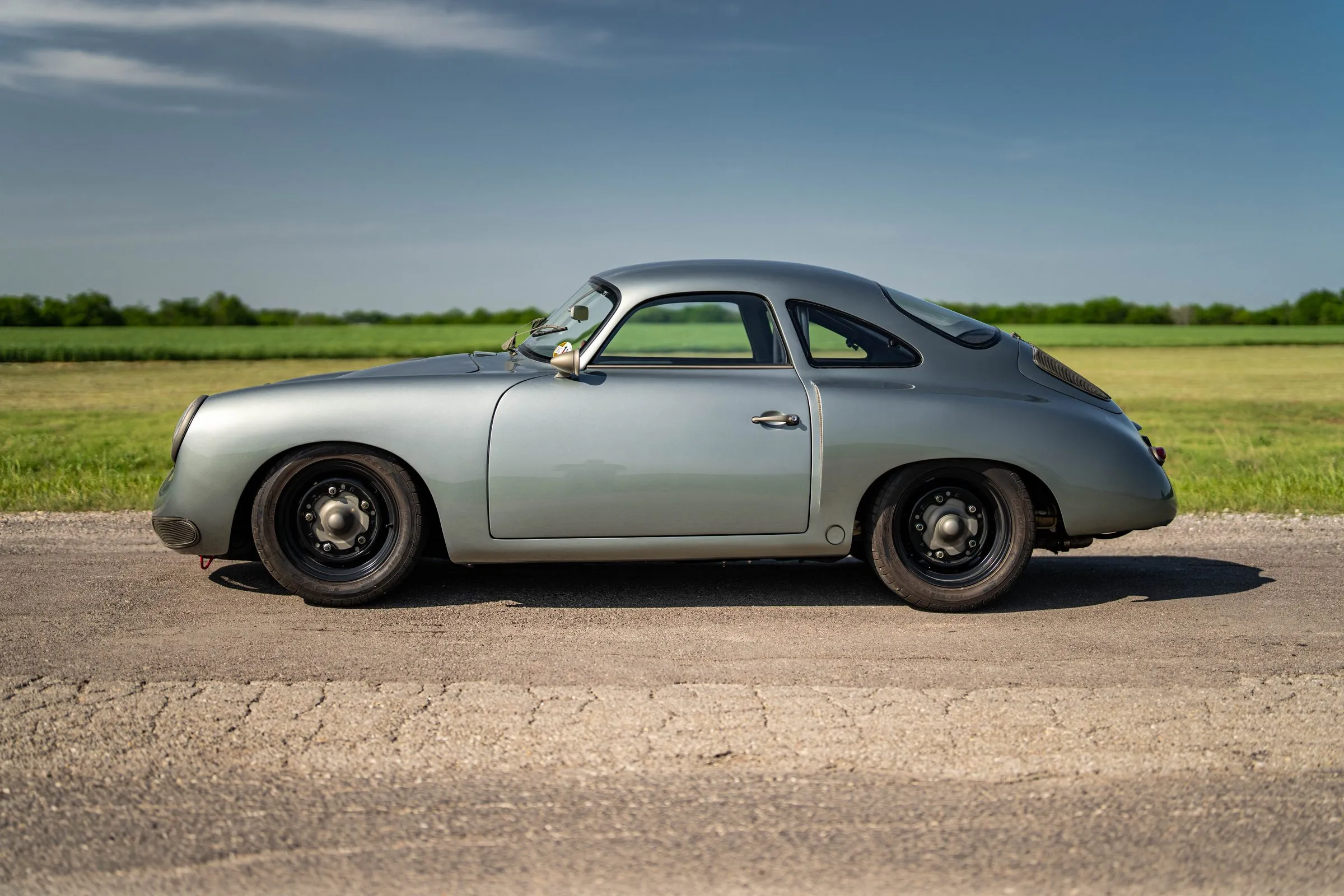
Every Outlaw 356 has its signature gesture. On this car, the gesture is the chop. Werks 11 cut the top of the car, lifted it, raked it forward, and welded it back. They built the new top using an A-front windshield and a C-rear windshield - both pieces of original Porsche glass, sized for different cars, married into a single profile.
CHAPTER V · THE ENGINE
A Type 4 motor, built like a 911R wished it could be.
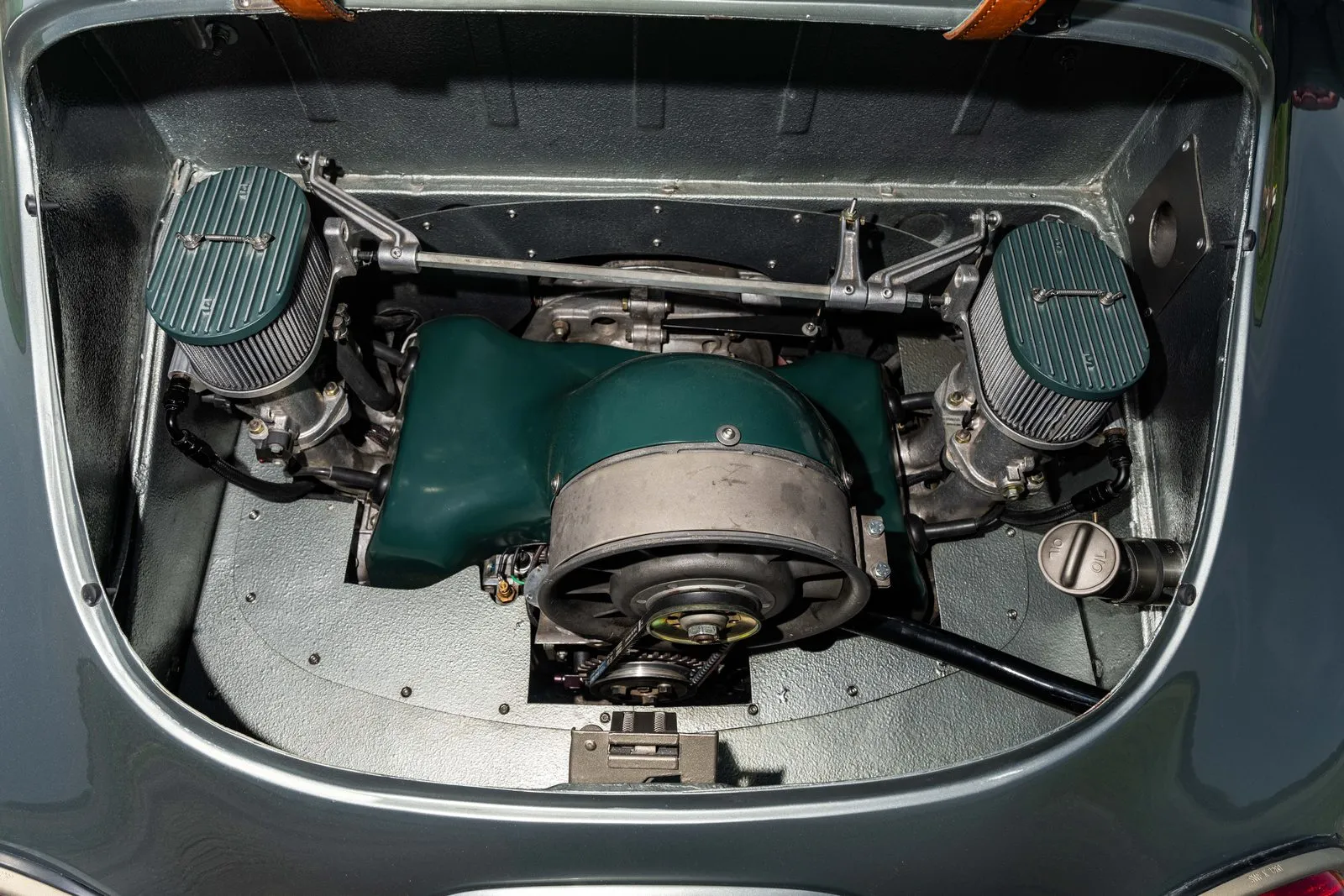
The original 356 motor made about 60 horsepower from 1.6 liters. The motor in the back of this car makes more than twice that, and most of the time you can’t hear it.
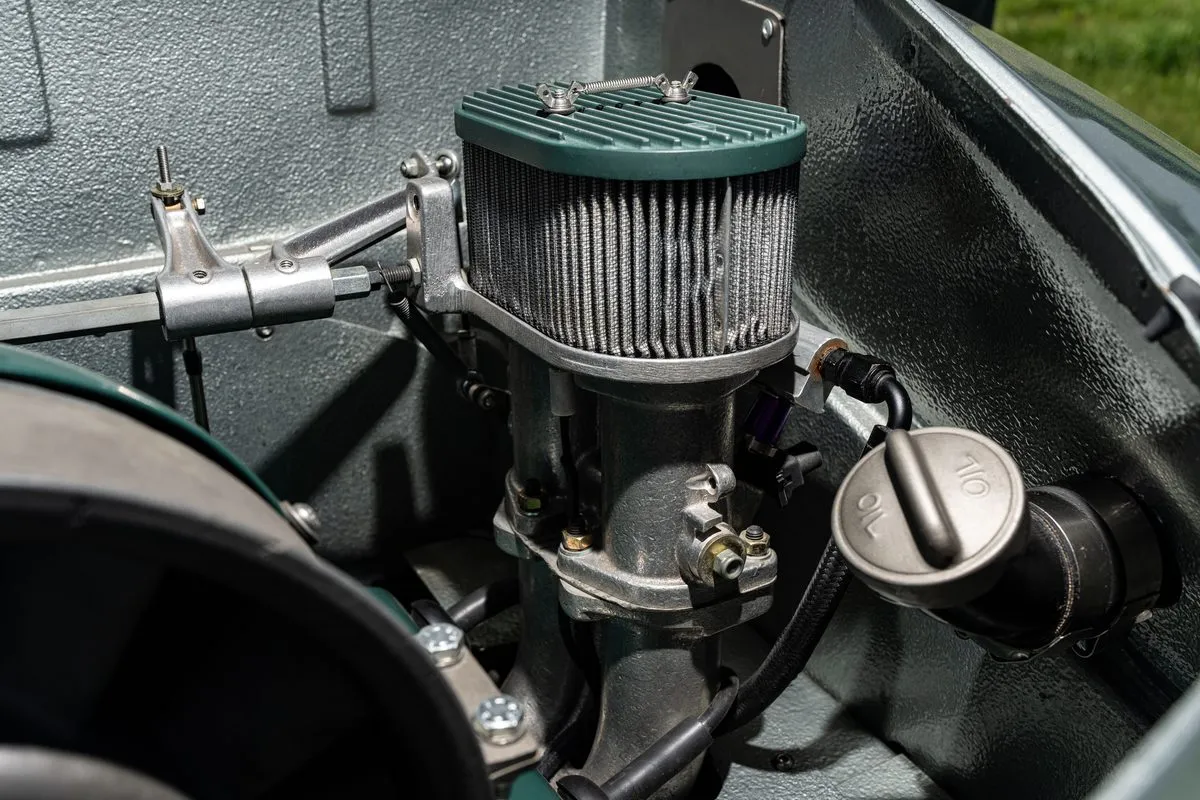
Open the engine lid and the first thing visible is the four-vent treatment - necessary heat management, but also a clue to what’s underneath. The motor is built from Werks 11’s 914 race-program DNA, detuned for road use, with individual throttle bodies in place of the old carburetors and a Link ECU running modern injection. The headers are custom; the exhaust is a Porsche 997 center muffler, modified to fit. The note is muscular but not loud.
Most of the work that makes a great car great is invisible. That’s the deal.
CHAPTER VI · THE FINISHES
Salzach silver, named for a river photo.
The color was the longest decision of the build. About ten options were considered. The one that won arrived in an email from Brett and Jessica while they were traveling in Germany - a photograph of the Salzach River.
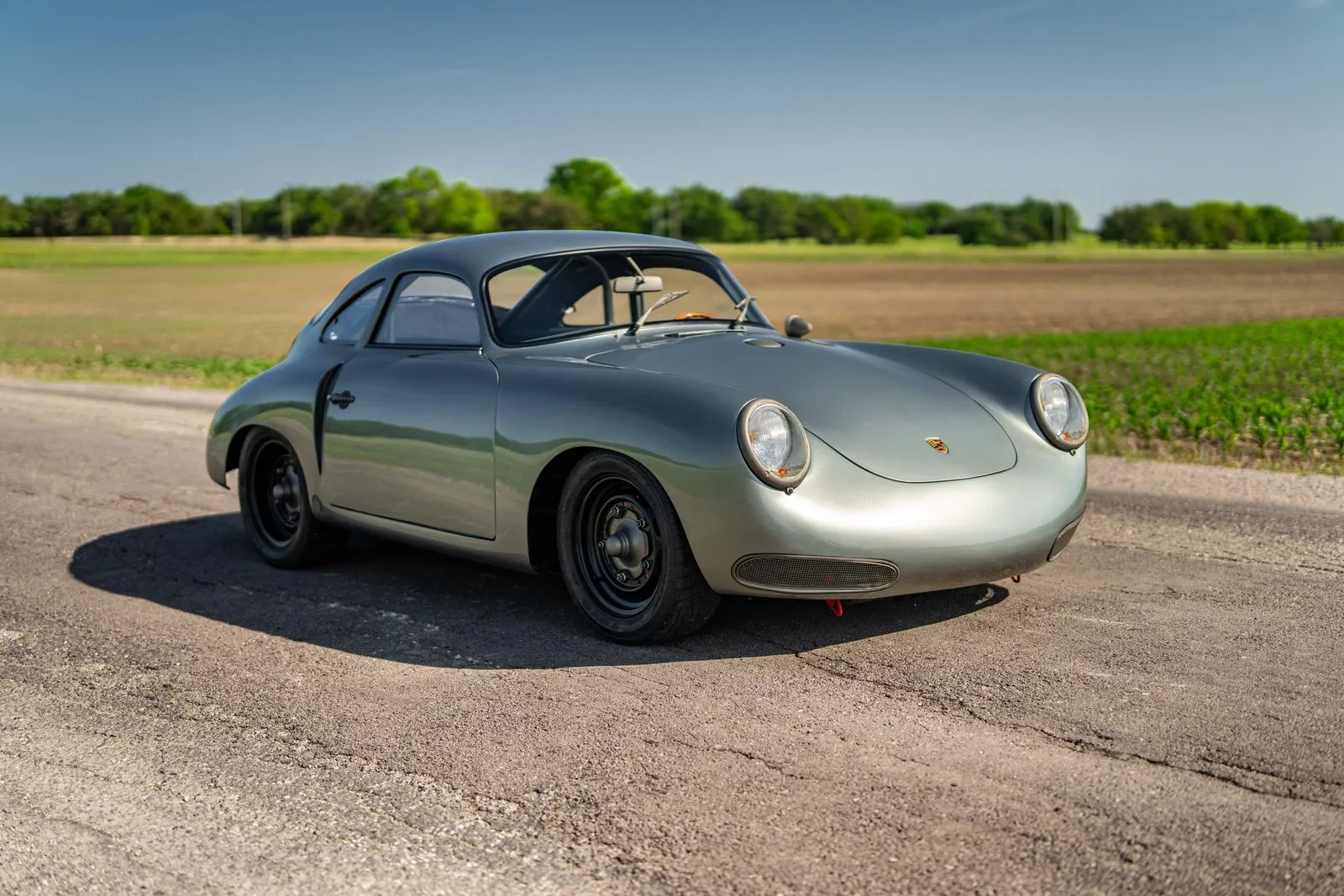
The Nelsons leaned, initially, toward the typical 356 Outlaw palette: black, silver, gray. Julian had painted a lot of cars in that palette. He pushed back. He wanted to see something else. What broke the deadlock was a photograph. Brett and Jessica were in Europe. The email arrived from Germany with a single image attached - the Salzach River, the water carrying a particular kind of mineral green-gray that shifts depending on the light.
CHAPTER VII · THE INTERIOR
Bespoke knobs, a donated steering wheel.
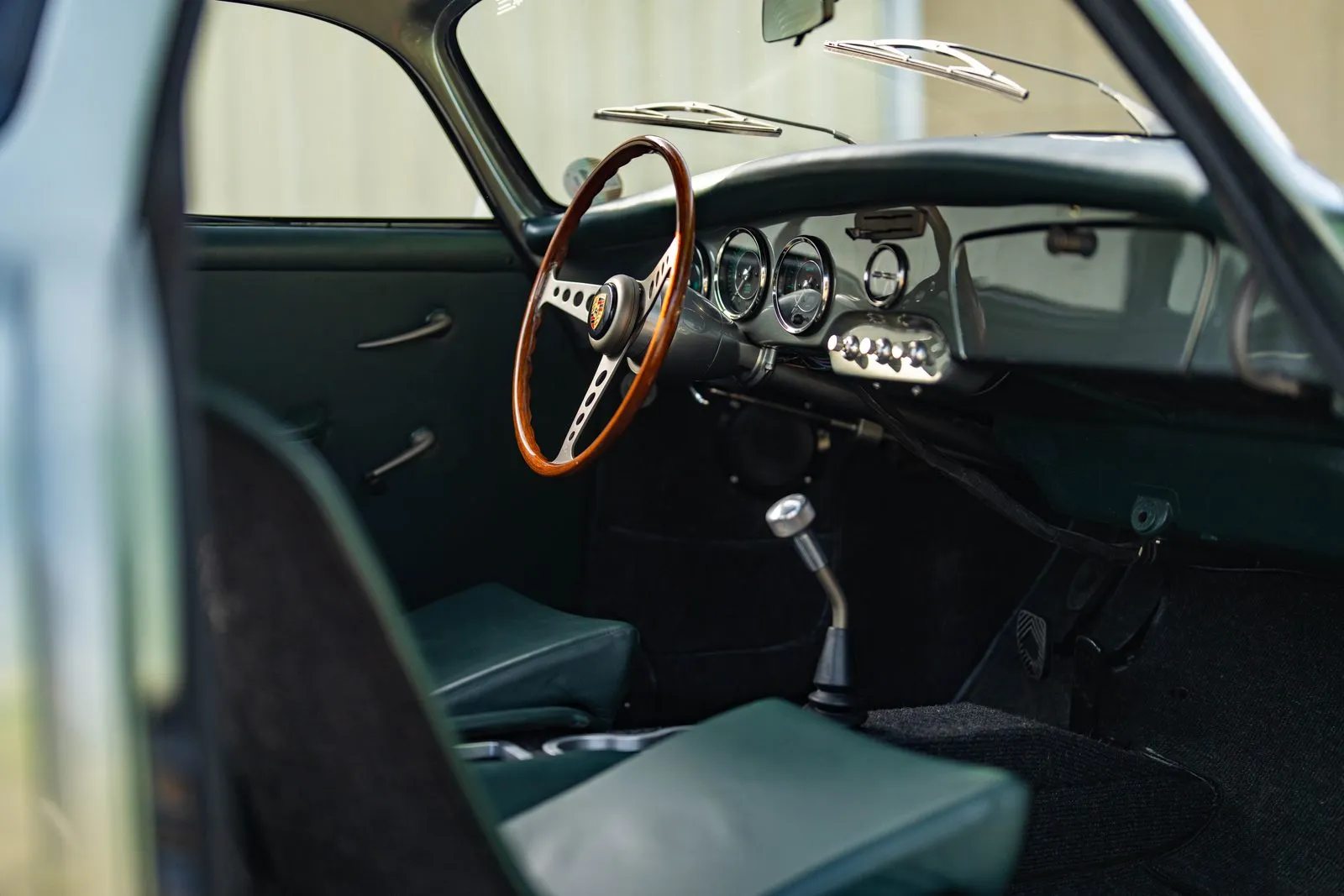
The interior was where the build’s network of contributors became visible. A friend named Sean made the knobs. A friend named Christian donated the wheel. Jessica asked for a center console. Werks 11 did the rest in leather.
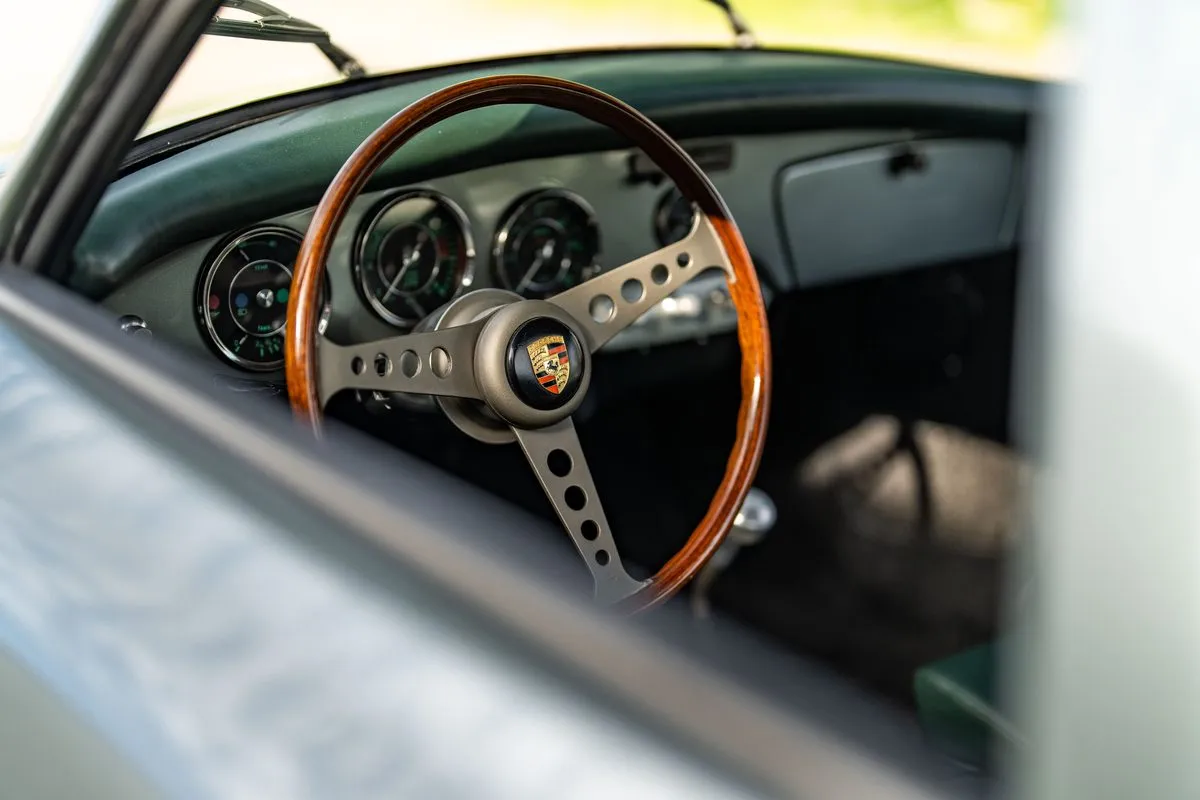
The interior is where you most clearly see that this build was not the work of a single shop in isolation. It was a network. Werks 11 designed the architecture. Sean - an expert CNC machinist and longtime friend of the shop - designed and made every knob in the car. Christian, a good friend Brett had met at Hill Country Rally, donated the steering wheel. Brett and Jessica brought a center console request - Jessica wanted cup holders, plural. Werks 11 designed the center console around her ask.
CHAPTER VIII · THE MECHANICAL
Three sets of glass, one suspension.
The hardest detail of the entire build was something most people don’t notice: the side glass. Tempered, custom, frameless. It took three tries to get it right.
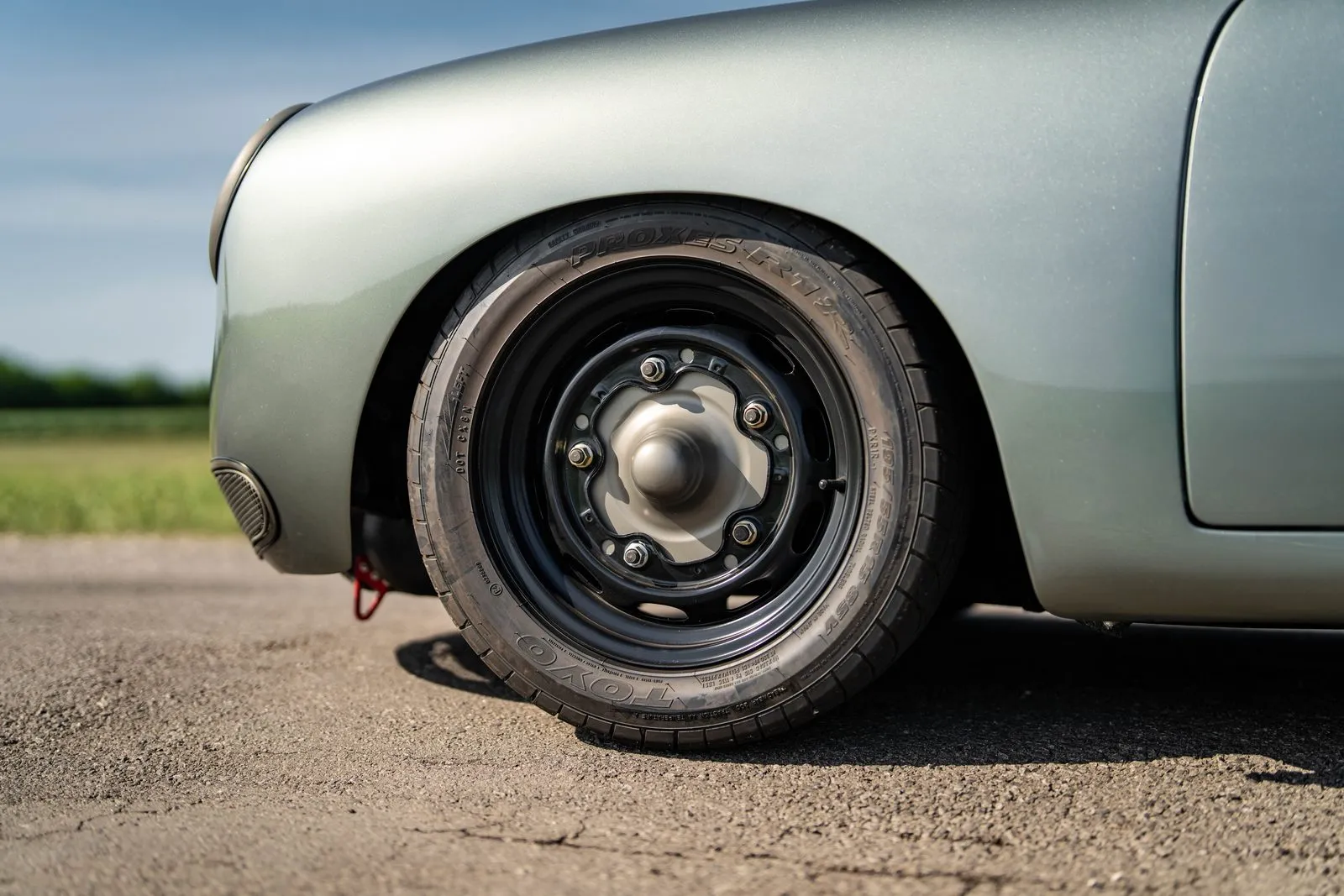
The suspension is a hybrid: Bilstein, KW, Elephant Racing. The KW units sit at the front, where their adjustability allowed the team to get the ride compliant despite the car’s low stance. Most 356 Outlaws use Lexan side windows. Julian didn’t want Lexan. He wanted real glass - tempered, frameless, safe. It took three sets to get there.
Chassis & Glass
- Front suspension
- KW (adjustable) + 1-inch drop spindle
- Rear suspension
- Bilstein
- Other components
- Elephant Racing
- Wheels
- Widened to 6.5 inches all around - black
- Tires
- Square setup - same size all around
- Trim
- Cerakoted titanium throughout - no chrome
- Front windshield
- A-front (original Porsche) - 1.25 inches lower than stock
- Rear glass
- Original Porsche C-glass
- Side glass
- Custom tempered, frameless - three sets attempted
CHAPTER IX · THE TESTING
Twelve hundred miles before handoff.
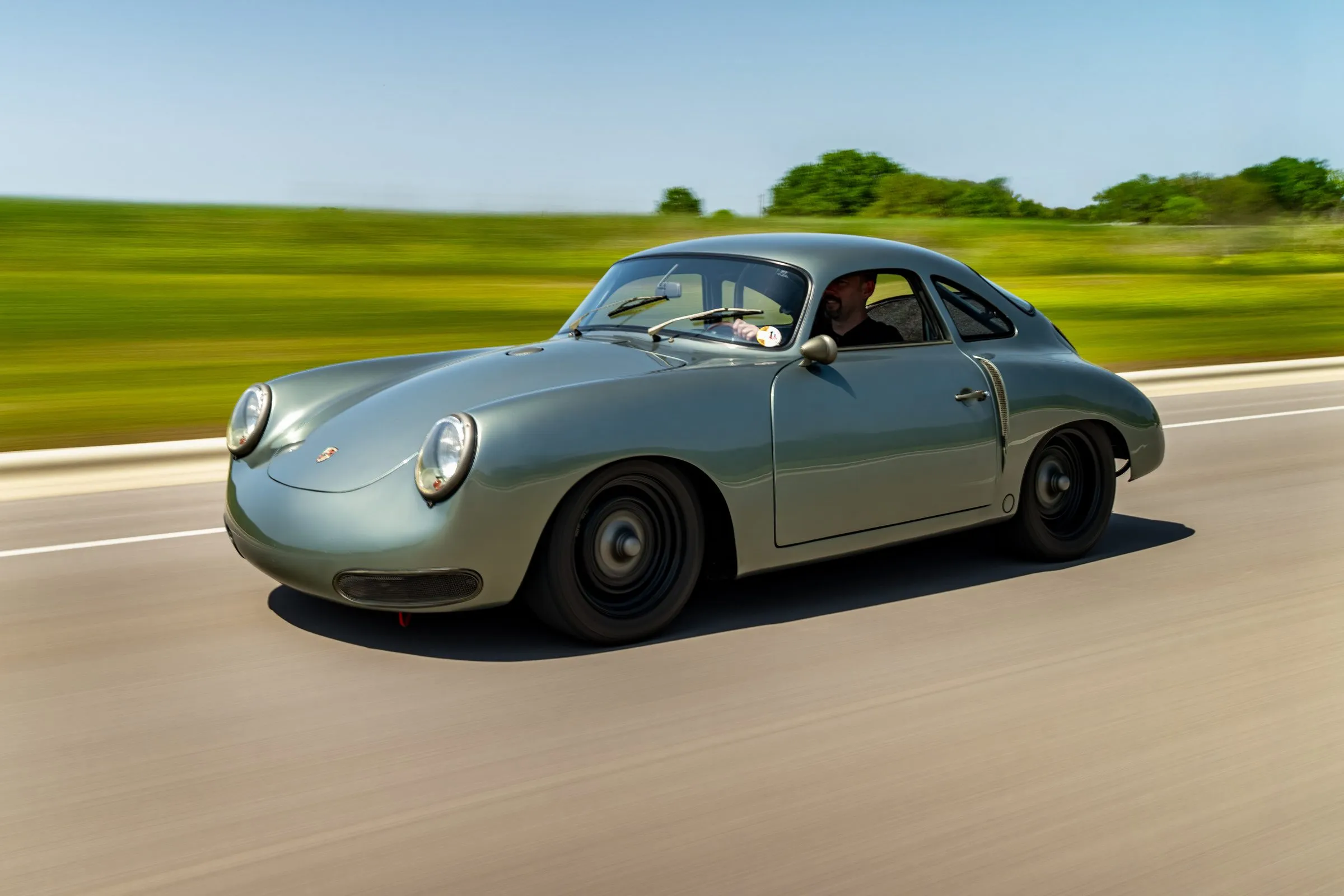
Werks 11 built this car with the explicit intention that it would be driven across state lines. Brett asked for it. Julian agreed. The shop spent twelve hundred miles making sure the answer was real.
A car like this one - chopped, lowered, custom-glassed, ITB-fed - could easily have ended up as a trailer queen. Pristine at the show, useless on the road. The Nelsons explicitly didn’t want that. They run multi-day rallies with their Midtown Autohaus clients across Oklahoma, New Mexico, Colorado, and Utah. They wanted a car that could go. Werks 11 spent the last year of the build testing - suspension setups, tuning, drivability - putting about twelve hundred miles on the car before turning it over.
CHAPTER X · THE SHOWING
Rennsport. Manual Focus. Luftgekuhlt.
A car like this one announces itself by where it gets invited.
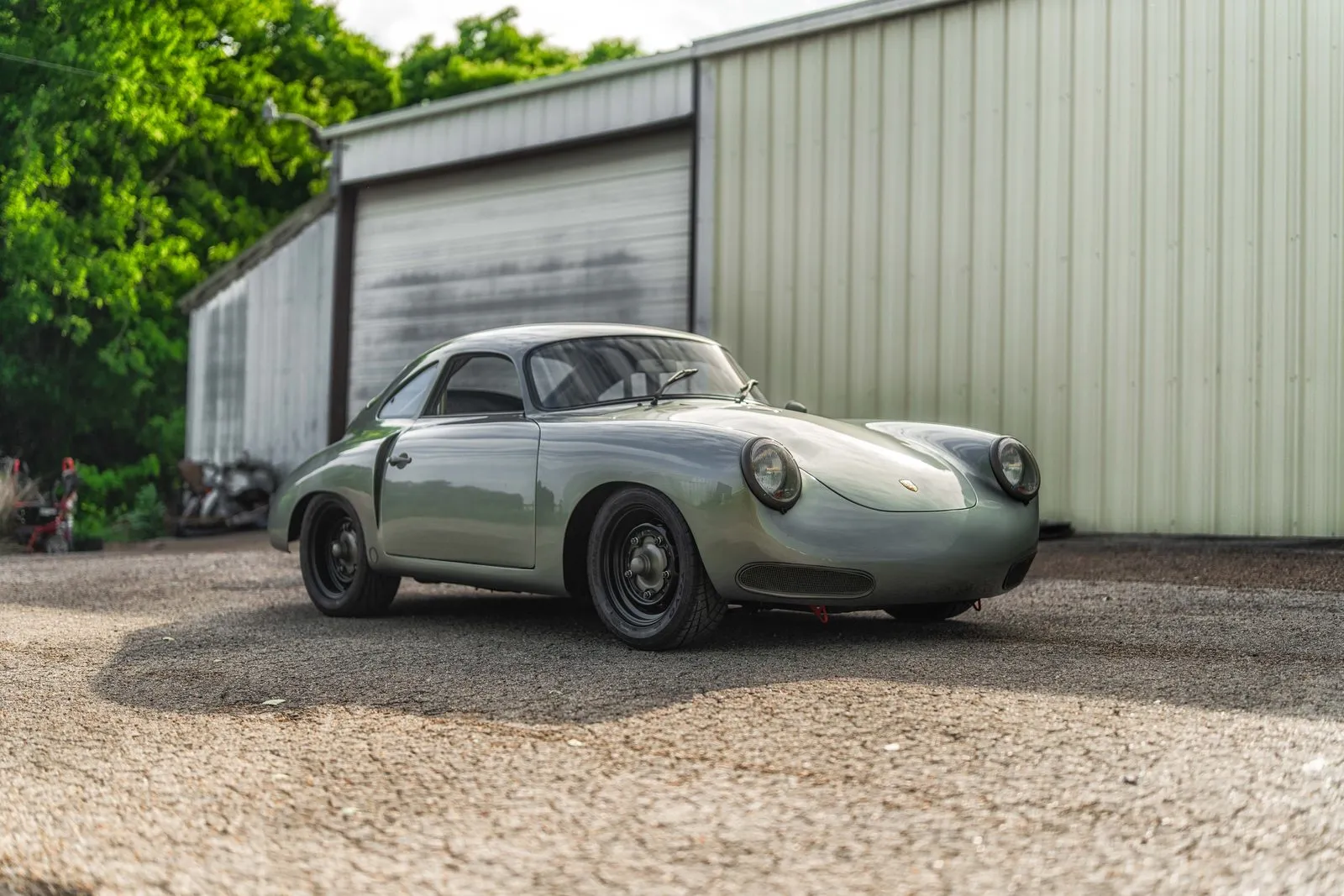
When the build was complete, Werks 11 and the Nelsons started showing the car. The first major outing was Rennsport Reunion 7 at WeatherTech Raceway Laguna Seca - the most respected gathering of Porsche owners and Porsche history in the world. The car was selected to be in a special paddock dedicated to Outlaw 356s. Approximately fifteen cars were chosen across the country. The Werks 11 / Midtown Autohaus 356 was one of them.
If you stand around the car for five minutes, you don’t see what’s been done. If you stand around it for fifteen, you start finding edits. That’s by design.
Show Provenance
CHAPTER XI · THE LANDING
Far greater than they could have imagined.
The Nelsons dropped the car off in 2021, unsure what the design process would produce. Two years later they had something they describe as a piece of automotive art and the start of lifelong friendships.
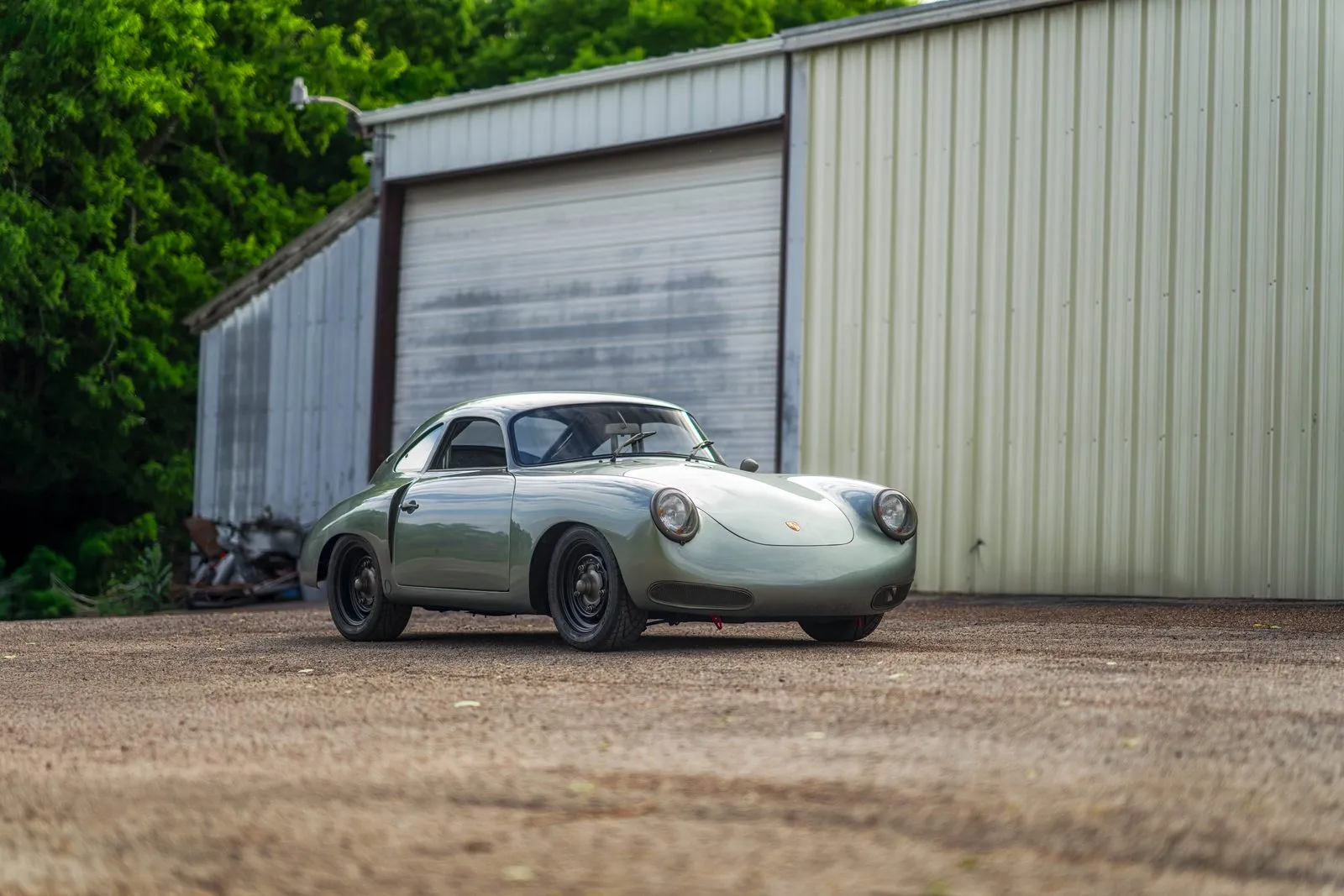
The car lives now at Midtown Autohaus in Oklahoma City, where it joins a rotating collection of stored cars belonging to the facility’s members. It still gets driven. It still gets shown. The relationships that produced it - between Brett, Jessica, Julian, Sean, Christian, and the rest of the network of contributors - have outlasted the build itself.
Where to learn more
COLOPHON ·ABOUT THIS DOCUMENT
A Note on Method & Matter.
A brief word on how this document was prepared, the sources it draws from, and the partnership behind its construction.
This document was prepared as a long-form profile of the Werks 11 / Midtown Autohaus 1956 Porsche 356 Outlaw - an ongoing collaboration between Brett and Jessica Nelson of Midtown Autohaus in Oklahoma City and Julian Avent of Werks 11 in central Texas.
The narrative draws from a primary interview transcript recorded with both Brett Nelson and Julian Avent, supplemented by photography provided by IMG88.
Build specifications, component selections, paint origin, suspension setup, glass sourcing, and show provenance are taken from those sources directly and confirmed with the parties involved before publication.
Photography credit: IMG88. The full photographic record is owned by the photographer and used here with permission.
Sources & Contributors
- Primary interview
- Brett Nelson (Midtown Autohaus) and Julian Avent (Werks 11)
- Photography
- IMG88
- Build credit
- Werks 11 (build, paint, upholstery, fabrication)
- Bespoke fabrication
- Sean - CNC knobs throughout
- Steering wheel
- Christian - donated, supplied at Hill Country Rally
- Color name
- Salzach silver - mixed by Werks 11 from a Salzach River photograph
Dedication
For the people who decide a thing is worth two years.
Meridian 98 · Issue 001 · Build Story
Set in Playfair Display & Inter
98° W · Oklahoma · MMXXVI